
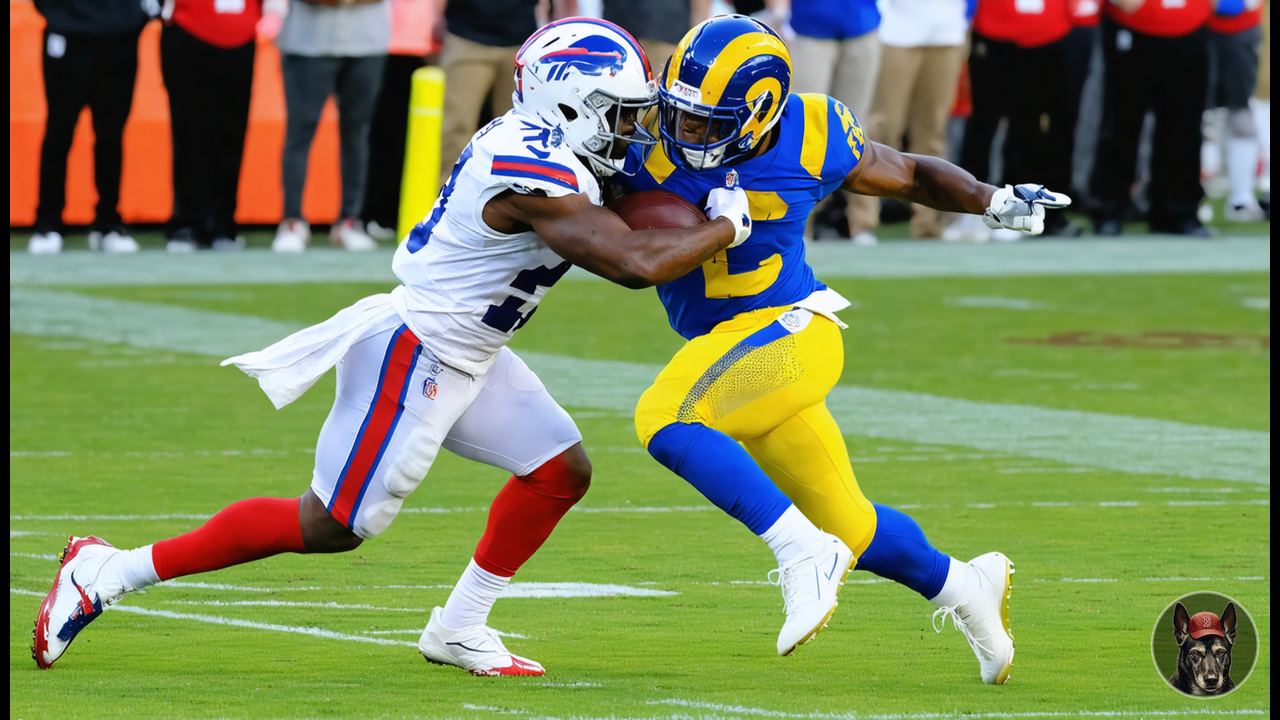
Los Angeles Rams vs. Buffalo Bills: Sharp Betting Preview
This inter-conference cross-country battle featuring the AFC East vs the NFC West brings two conference titans to SoFi Stadium for what projects as one of Week 5’s marquee matchups. The Buffalo Bills travel west to challenge Sean McVay’s Rams in a contest that has already drawn sharp market attention, with early action pushing both the spread and total in telling directions. Both teams arrive battered by injury attrition, but the Bills face significantly deeper roster depletion on both sides of the ball—a reality that will directly influence how this game unfolds and, more importantly, where smart money is finding value.
Game Preview & Market Consensus
The Rams opened as modest 2.5-point home favorites, and that line has proven sticky across the market consensus. The spread has settled in the -2.5 to -2.5 window with minimal movement, signaling confidence from the market in Los Angeles’ ability to win a home game against a quality opponent. Buffalo is being offered anywhere from +2.5 to +2.5 depending on shop, reflecting the tight nature of the matchup and substantial mutual respect between these franchises.
The total is where the market has shown more volatility and intrigue. The over/under consensus hovers in the 52.5 to 53.5 range, with the market leaning toward modest offensive output. This is notably restrained for a matchup between two teams with legitimate passing attacks. Josh Allen’s Buffalo offense and Matthew Stafford’s Los Angeles attack should theoretically generate scoring, yet the total’s placement suggests sharp money believes either defensive performance or field position management will keep this in a controlled, lower-scoring affair. The under has attracted early action, a tell-tale sign that sharp bettors are factoring in the injury-induced personnel loss on both rosters.
Roster Absences & Tactical Impact Analysis
The Bills’ injury report reads like a defensive scheme nightmare. Ed Oliver, their DT listed as a Day 1 starter on the depth chart, is out for Week 5, forcing Buffalo to rely on secondary defensive line depth. More critically, cornerback Jordan Hancock is on injured reserve through Week 8, removing a key member of the secondary in pass coverage. DJ Moore, Buffalo’s WR3, carries questionable status after limited practice, and Josh Palmer (WR depth) is ruled out entirely. The Bills secondary is further compromised: Dee Alford (CB, DB5) is questionable, and Jordan Poyer (FS) is also questionable entering the week. Linebacker Demetrius Flannigan-Fowles adds another questionable tag to an already fragile coverage unit.
The cumulative effect is severe: Buffalo’s defense will likely field a patched-together secondary with multiple starters or established depth players potentially unavailable. Matthew Stafford, operating within a Ryan-McVay system designed to exploit coverage weaknesses, faces a Bills secondary in flux. Davante Adams and Puka Nachua have legitimate one-on-one opportunities against a back-up-heavy Buffalo corner rotation.
Los Angeles’ injury toll is less punishing but still material. Myles Garrett (LB/DL11) is on injured reserve through Week 7, and Ronnie Rivers (RB depth) won’t return until Week 7. Quentin Lake (SAF, DB1) is questionable after limited practice—a potential loss that weakens safety coverage against Allen’s downfield progressions. However, the Rams’ core offensive weapons remain intact: Kyren Williams (RB1), Matthew Stafford (QB1), and a full complement of receiving threats including Davante Adams and Puka Nacleua are ready for deployment.
The asymmetry in injury impact cannot be overstated. Buffalo’s defense will be operating significantly below optimal strength, while Los Angeles’ offensive skill positions remain largely available. This creates a fundamental edge for the Rams’ scoring potential and directly supports the under—if the Rams can efficiently move the ball and score, Buffalo’s offense may need to keep pace against a Rams defense that, while compromised at linebacker, remains structurally sound at the line of scrimmage.
Optimal Value & Predictions
From a sharp value perspective, there are two primary plays worth targeting:
1. Los Angeles Rams -2.5 — The consensus line has settled at a mathematically fair number, but the underlying roster composition favors the home team decisively. With Buffalo’s secondary compromise and Los Angeles’ offensive depth remaining intact, the Rams should win field position and offensive efficiency battles. The Bills’ best path to victory requires a dramatic defensive performance from a battered unit, an unlikely scenario in SoFi Stadium’s environment.
2. Under 52.5 / 53.5 — While both offenses possess legitimate talent, the Bills’ defensive attrition will force Buffalo into potential negative scripts early. Once the Rams establish offensive rhythm, McVay’s system thrives on clock management and controlled possession. Buffalo’s offensive line remains healthy, but without a dominant secondary, the Bills will struggle to maintain offensive rhythm against a Rams pass rush that doesn’t need to be elite—it just needs to be more functional than Buffalo’s injury-plagued coverage. The under attracts sharp money for good reason: this game has all the hallmarks of controlled tempo and field position management over a shootout.
Sharp Report Lean:
- Primary Play: Los Angeles Rams -2.5 (DraftKings consensus) — Home-field advantage + roster superiority in secondary coverage situations = edge for McVay’s offense and pressure on Allen
- Secondary Play: Under 52.5 (FanDuel consensus) — Defensive attrition on Buffalo side creates game script favoring possession football, clock management, and controlled scoring
- Key Monitoring: If DJ Moore (WR3, questionable) or Jordan Poyer (FS, questionable) are ruled OUT closer to game time, both plays gain additional conviction. A Bills secondary without Poyer and Hancock is dangerously thin
- Avoid: Lean away from Buffalo +2.5 chalk—traveling cross-country with a compromised secondary against a home team with functional offensive weapons is a recipe for negative value